Integrated Rubber Farming System: The Panacea to Ailing Rubber Sector
- Aug 25, 2016
- 3 min read
IPIL, Zamboanga Sibugay --- He slashed some shrubs that grow aplenty underneath the rubber trees. “Snacks for my sheep,” Engr. Bennet Santander grins as he casually walks towards a shed where his sheep were kept.
“I started with a pair of sheep,” the 65-year-old industrial engineer said while feeding the sheep. The pair has multiplied thrice since.
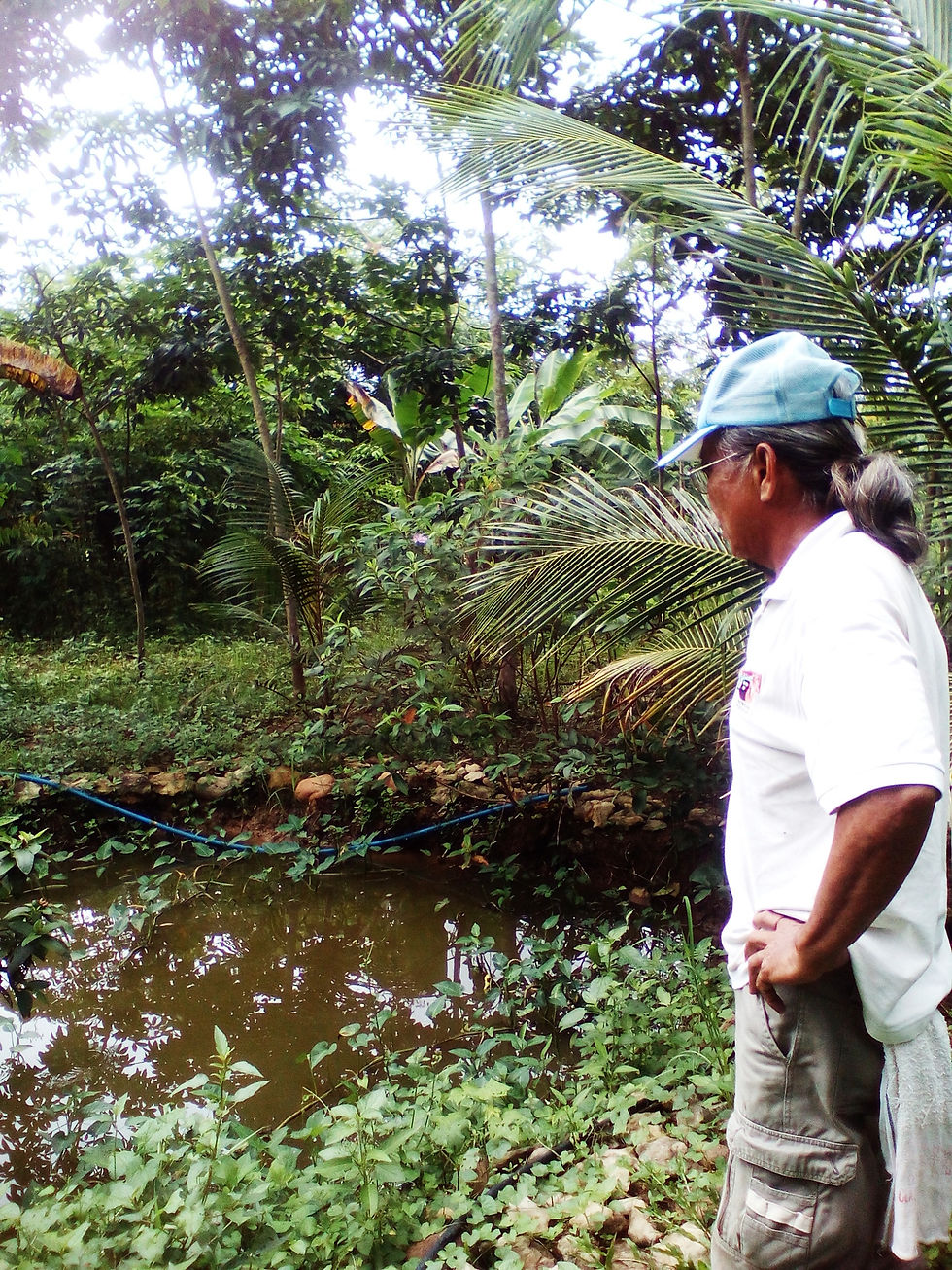
The shed for his sheep was nestled comfortably near his rubber forest. Some meters away from the shed was his fishpond where he cultured tilapia.
The pond, according to Santander, serves as “gestation place” until the fingerlings are ready for transfer to bigger pond, which is the 7,500 square meters ricefield.
“In my 1.5 hectares, I am able to utilize at least 5 hectares,” he paradoxically declared.
The industrial engineer was never wrong with his mathematics: He grew 1,000 rubber trees, which traditionally occupies 1.0 hectare; he cultivated a three-fourth hectare ricefield; he planted coconut trees, normally it occupies a half hectare of land; he cultured tilapia on a three-fourth hectare piece of land; he grew vegetables on a half-hectare land; maintained a budwood garden on a half-hectare; and grew a mix of dulaw (turmeric), and fruits.
He started developing the farm, which is located some 4 kilometers away from the national highway of Barangay Upper Pangi of this town, four years ago.
The decision to live in the farm and develop it himself was driven by the desire to come up with a “demonstration farm” that will showcase an integrated rubber farming system.
The core crop of the farm is rubber where he maintains a budwood garden of new clones of rubber from which he earns at least P300,000 annually.
“What I did was to plant the rubber seedlings spaced comfortably to allow other crops to grow,” he said. The 1,000 rubber seedlings were planted 2 meters between hills, and 3 meters between rows. For every three rows there is a space of 20 meters to another three rows of planted rubber seedlings.
At present, the rubber trees are tappable.
But during the gestation period of three years for rubber to be tappable, he sourced his income from his budwood garden, vegetable garden, ricefield, and fruits.
“There is food on my table from the produce of the land,” he beamed.
The key, he said, is to get the optimum yield for every square foot of land. The conservative estimate of his annual income is no less than half a million pesos.
“I am doing it and it is working,” he said.
The 65-year-old Santander has remained steadfast, however, in his advocacy for the rubber industry amid the problem besetting it.
The small rubber farmers, he said, can still do well even with “a little help from the government.”
The provincial government last year has established P30-million buffer fund for rubber to help out rubber farmers as the raw rubber farm-gate price continues to tumble.
“I am setting aside P30-million buffer fund for rubber,” Governor Wilter Yap Palma announced during the first meeting of the Zamboanga Sibugay Rubber Industry Development Board (ZSRIDB) last year at the Capitol Conference Room.
The buffer fund is intended to provide cushion for small rubber farmers who are hardly hit by the downward trend of trading price of raw rubber.
The governor told the members of the rubber board he is “committed to revitalize the rubber industry” in the province.
“We have to do something to the industry where thousands of Sibugaynons depend upon for livelihood,” he said in an interview.
The province is second only to North Cotabato, which is considered as the rubber capital of the country. The province ranked second in cup lump production in 2012. North Cotabato, a province in SOCCKSARGEN, registered the highest cup lump production in 2012. But recent statistics showed the province is the rubber capital of the country.
In 2012, Philippines had a total cup lump production of 442,998 metric tons. Zamboanga Sibugay accounted for 38% of the country’s total cup lump production. Collectively, Zamboanga Peninsula’s percentage share to country’s cup lump production in 2012 was about 43%. 75% of the region’s production came from Zamboanga Sibugay.




Comments